
Creating Unusual Melodic Connections
Are your solos as expressive and captivating as you wish they were? Most players aren’t too sure.
Some folks think Charlie Parker and the other masters were born great. That’s nonsense! Bird worked hard at his craft. He mastered the vocabulary that mattered for saying what he wanted to say.
In his powerfully witty book, “The Elements of Eloquence,” Mark Forsyth asserts it’s the skillful, deliberate use of rhetorical figures that distinguishes wonderful wordsmiths like Shakespeare from average authors.
In the same way, your solos become much more compelling when you learn to use jazz idioms creatively to express your own musical personality.
“Spaghetti logic” helps you use rhythm, phrasing, and unorthodox note choices to catch the ears, hearts, and attention of your listeners. In a nutshell, here’s how it works:
- Start with a simple musical idea.
- Play it repeatedly over the harmony.
- Experiment with varying rhythms, articulation, and melodic direction.
- Listen for something interesting.
- Refine the phrase by adding, changing, or removing notes.
- Continue until the phrase satisfies your ear.
Below are three examples showing how you might flesh out this idea.
1. WORKING OFF OF A SCALE
Start by playing an ordinary major scale.

OK, not extraordinary, right? But now, let’s add some basic jazz rhythmic figures.
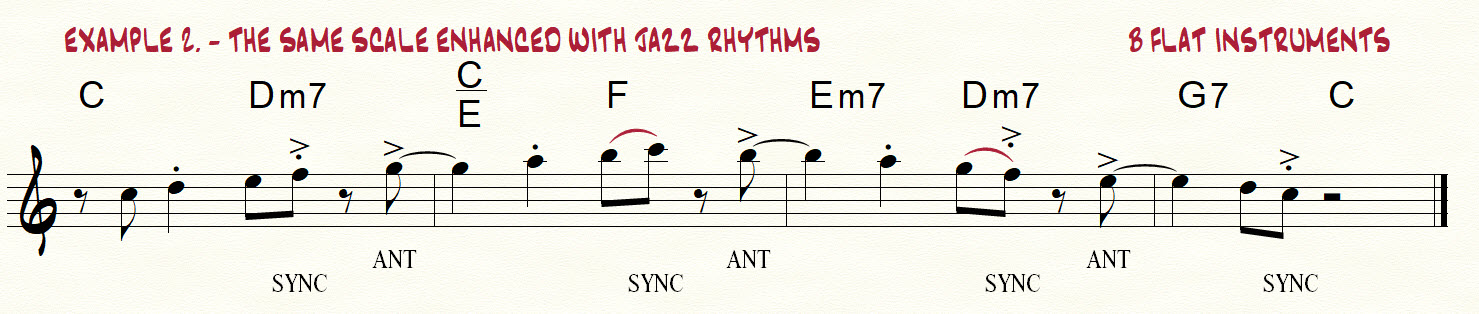
What’s different here? We’ve invested our heart and soul into this phrase. We’re actors. We’re no longer just reading from the phone book. We’re bringing a lifeless script to life. The notes are the same, same pitches. But now, there’s real-world articulation.
- We’ve added four syncopations (marked SYNC). These are notes that are accented or stressed on normally weak beats or subdivisions.
- And we’ve added three anticipations (marked ANT), notes played sooner than expected.
Those unanticipated rhythmic shifts add surprise and excitement to your delivery. Take a moment to experiment with various ways you might use rhythms like these on a scale to add interest.
The next step I refer to as “spaghetti logic,” because the melodic line skips around in unorthodox, tangled up shapes. I’ve been experimenting with this idea for several years, but I’m still not entirely sure how to explain or break it down.

Play this passage a couple of times and see if you can tell how it might have evolved from that original scale.
So, how did I arrive at that phrase? Well, I just started playing over the chords until I found a melodic contour that felt right.

For a moment, try to envision Michelangelo massaging a marble slab, shaving off a little here, smoothing a little there until “David” finally emerges. In a nutshell, that’s how the organic process happens. You play it first and explain it later. Hopefully you have some fun along the way!
You keep jamming, experimenting, refining, removing whatever doesn’t sound right. Eventually, a melodic contour emerges that satisfies your aesthetic sensibility. You start with a simple idea. But through the process of improvisation, the sound begins to take on a life of its own, and it leads you where it wants to go.
I didn’t arrive at this phrase by following a formula. It evolved as I played. The theoretical explanations came afterward.
Here is a technical description. If it helps, use it. If not, ignore it.
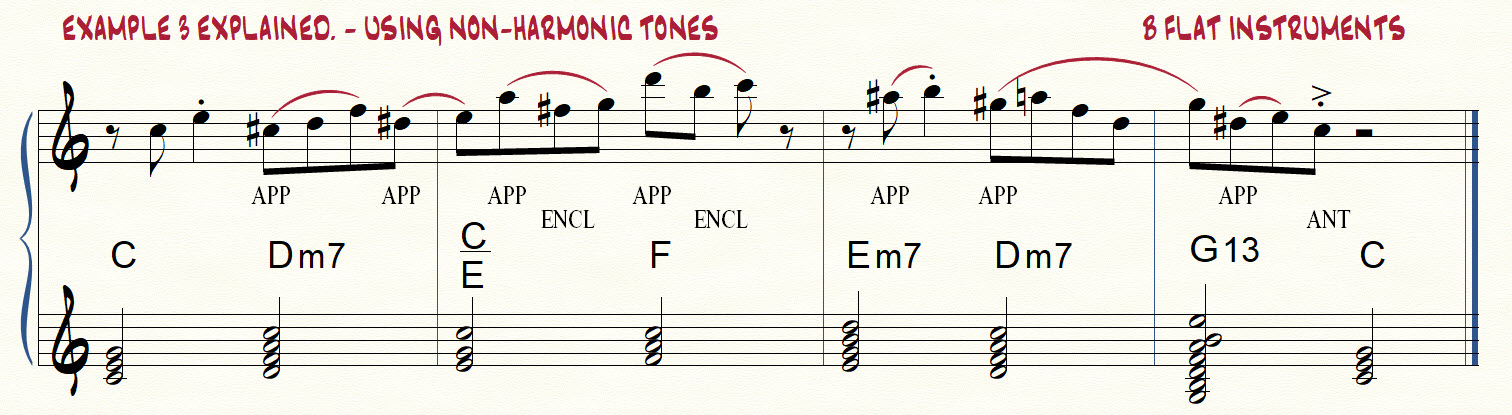
Most of the pitches in Example 3 are notes from the chord: They’re “harmonic tones.” The pitches not contained in the chord are “non-harmonic tones.” They give you colors to approach and embellish chord tones in unusual ways, creating interest without losing your connection to the underlying harmony. I’ve labeled them this way:
- APP = appoggiatura: Leap toward a non-harmonic tone, resolve by step in the opposite direction to a harmonic tone.
- ENCL = enclosure: Surround a harmonic tone by playing the pitches above and below it before landing on it.
- ANT = anticipation: Play a tone that anticipates the chord which follows.
Another description some players find helpful is to speak of a “chromatic approach note,” approaching a chord tone using a non-harmonic tone a half-step away from it.
What I did here was to begin with an ordinary major scale and allow the phrase to take on a life of its own through trial-and-error improvisation. Notes are added, altered, approached from unexpected directions, and connected through appoggiaturas, enclosures, and chromatic approach tones. Some notes seem to anticipate the harmony. Others seem to contradict it, only to resolve a moment later. Perhaps, the original scale gets obscured, but the musical logic endures.
Maybe that’s the real lesson: Theory doesn’t always tell us where to go. Sometimes it helps us understand where we’ve been. You’re not sure why you played that note, it just felt right! The ear is the sculptor. Theory is the art historian.
2. A DESCENDING SCALE OVER A V-I PROGRESSION
Here’s another example. It’s a descending scale over a V-I progression. Again, rather prosaic, rather plain.

But – if we add some syncopated rhythms – I think that scale starts to sound a whole lot more engaging.

And, once again, if we stick with it, looping the V-I progression using Band-in-a-Box or GarageBand, we end up with something like this.
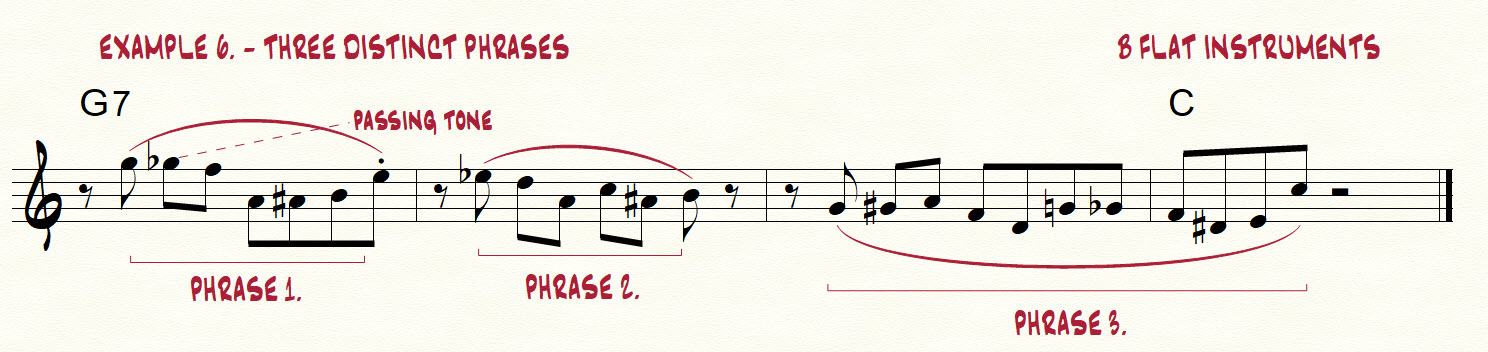
I’ve divided that long string of notes into three phrases. They’re delineated by slurs (also called “phrase marks”), and they’re like phrases written on a page (separated by commas) or spoken (separated by a pause).
Speakers who talk endlessly without pausing eventually lose our attention. We’re much more engaged by speakers who vary their delivery and give us occasional moments of silence to absorb and ponder what they’re saying. Music works the same way. Think about how Miles Davis uses space.
In addition to the devices described above, here I’m using “chromatic passing tones,” non-harmonic tones like the Gb in bar 1 separating two chord tones (G and F).
Example 6 introduces another intriguing idea; “multiple melodic contours.”
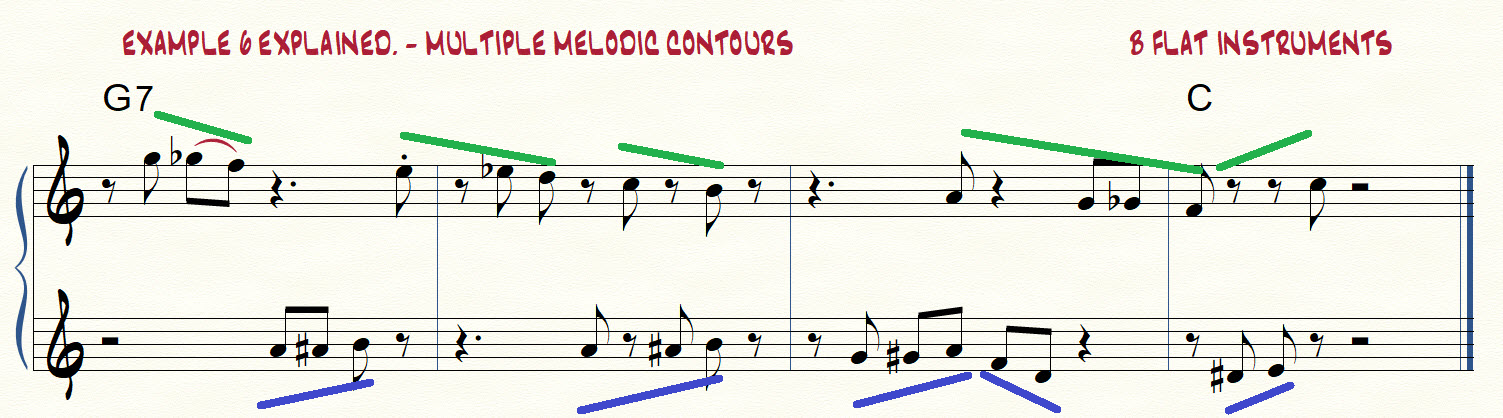

Sometimes a melodic line seems to contain two separate trajectories: an upper contour and a lower contour. It’s similar to looking at a mountain range and tracing two different ridge lines.
The music can move between these contours while retaining an overall sense of direction. You’ll hear players like Dexter Gordon or John Coltrane tracing out two or more semi-independent “ridge lines” while never losing the overall melodic flow.
3. WORKING IN A 12/8 SHUFFLE FEEL
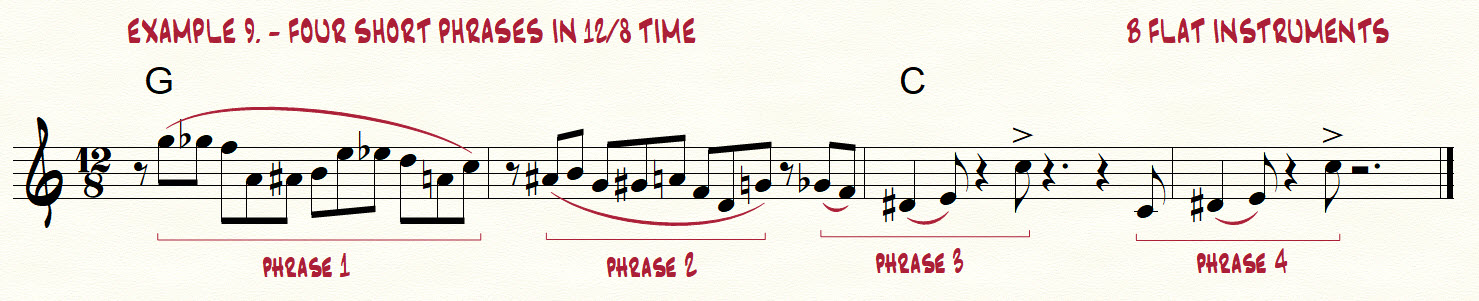
Here’s a similar descending scale over a V-I progression, this time with a 12/8 shuffle feel.

Again, it’s pretty prosaic. But simply adding basic jazz rhythmic figures begins to bring some bounce to it.

Example 9 uses the same sequences of pitches as Example 6, but this time using the 12/8 feel and breaking up the sequence into four short phrases. Notice how the four phrases add variety by starting and ending on different beats. Rhythmic variety is an essential part of a fresh, vigorous solo.
And finally, we present Example 10. Although it uses essentially the same set of pitches, the four phrases are divided differently.
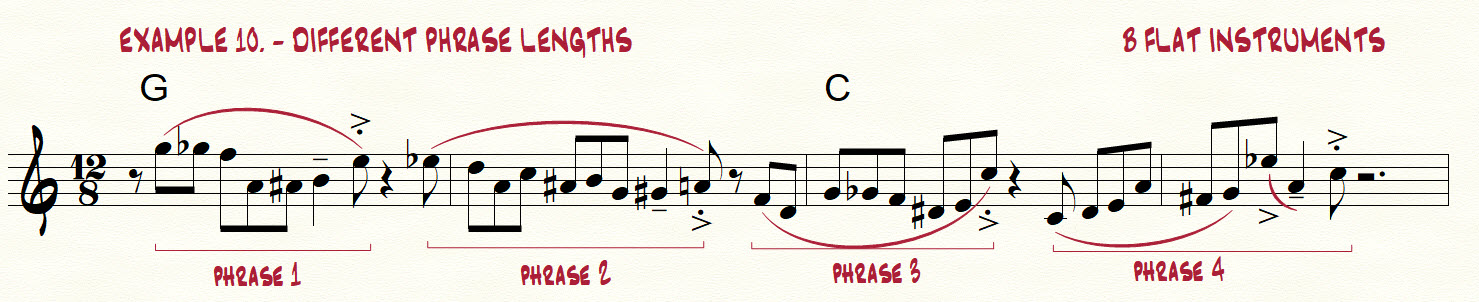
The first two phrases create what I call a “rhythmic sequence.” Although the pitches differ, the rhythmic profiles are similar (as shown in Example 11). The repeated rhythmic pattern gives the listener something familiar to hold onto, while the melodic material continues to wander in unexpected directions.

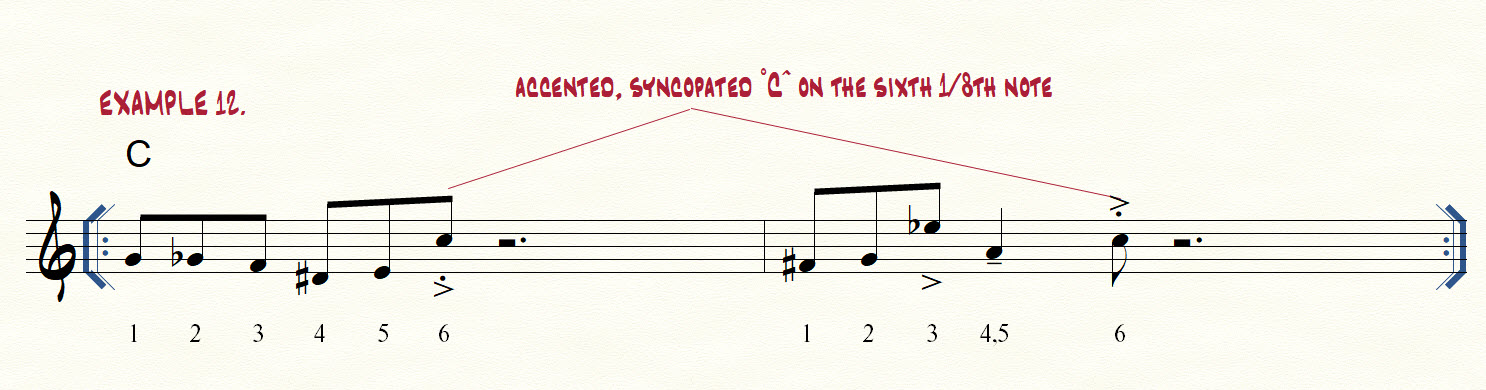
One last detail which adds a bit more unity is the repetition of the accented, syncopated C on the sixth eighth-note of both measures 3 and 4. At first, this point may seem obscure. But you’ll hear it if you repeat those bars several times.
I hope this post has given you a few new ideas to chew on to stimulate your passion for the exciting world of jazz improvisation. “Spaghetti logic” doesn’t mean abandoning musical coherence. It means creating unexpected melodic connections while retaining enough recognizable structure to make the music satisfying.
You don’t have to know exactly where you’re going before you start playing. Begin with a simple idea. Experiment. Listen. Refine. Let your ears guide you. Sometimes the most interesting discoveries happen when we stop thinking about the rules and simply listen to what we’re playing.

