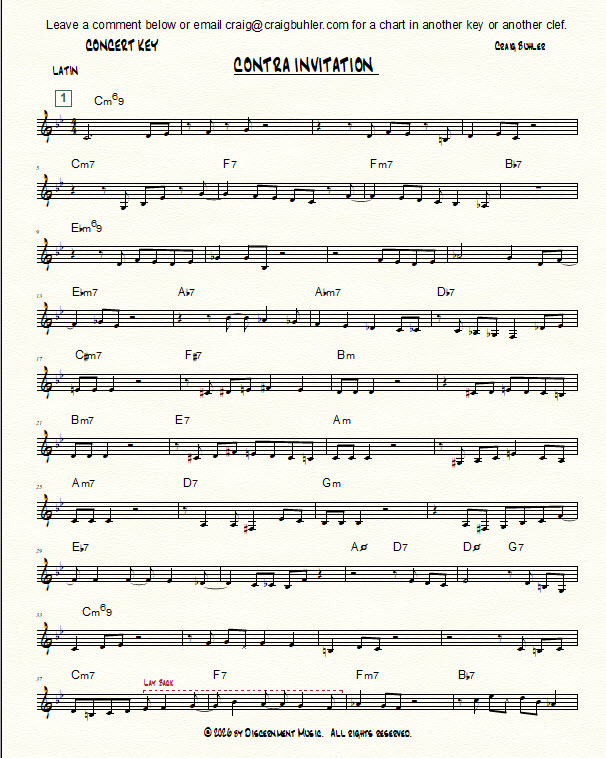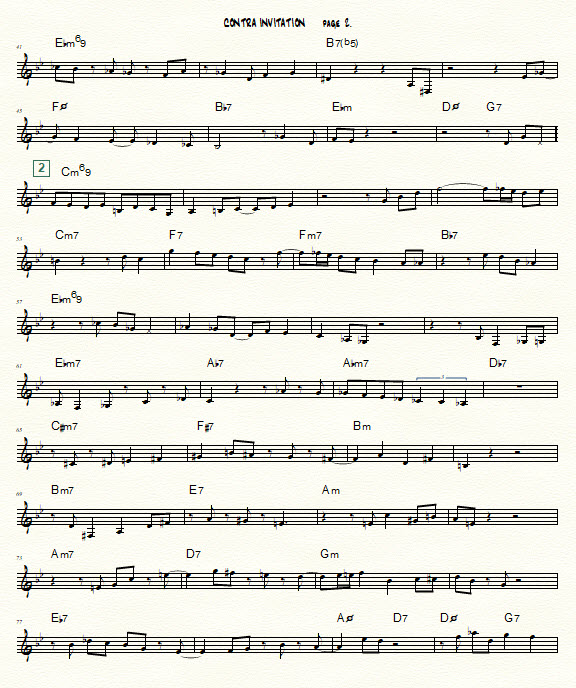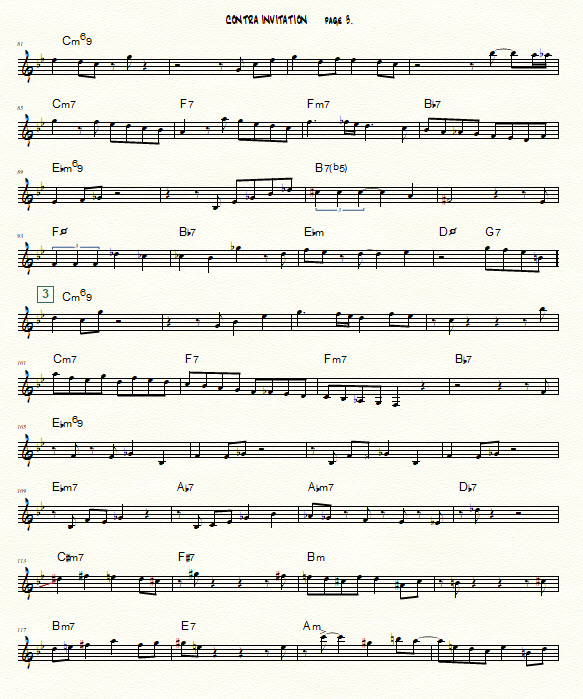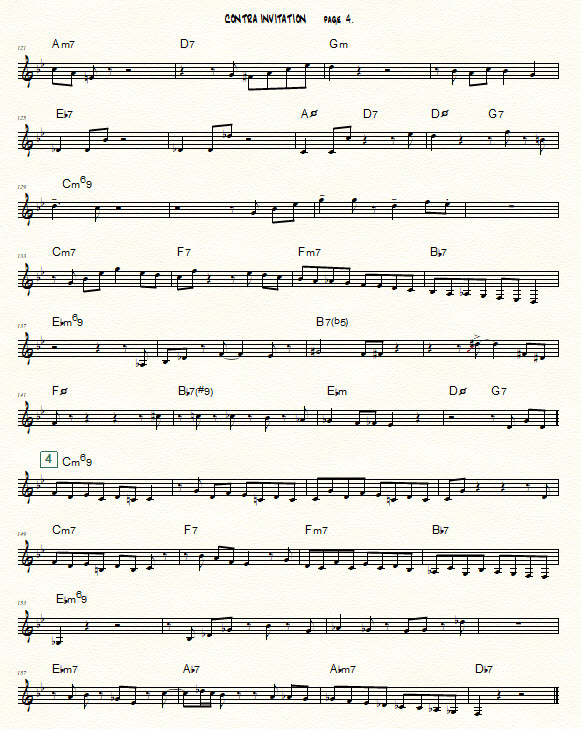
Bronislaw Kaper’s “Invitation“ has fascinated jazz improvisers for decades. Few standards combine modal harmony, rapid key changes, unusual melodic intervals, and dramatic rhythmic possibilities quite like this one.
Rather than simply sharing a solo transcription, I’d like to offer ten improvisational strategies that will give you ideas you can apply to almost any tune. To listen to Craig’s improv on the changes to “Invitation,” click on this MP3 player:
Click here to view a transcription of Craig’s improv.
Click here to watch the video on YouTube.
Contents: Four Elements of an Exceptional Solo
RHYTHM: THE SPARK!
- Begin Your Phrases in Unexpected Places.
- Experiment With a “Laid Back” or “Driving” Feel.
- Repeat a Rhythmic Motif.
MELODY: THE HEART
- Use Repetition to Add Unity.
- Grab On to Melodic Motifs.
- Try Creating Sequences to Lend Even More Unity and Variety.
- Create a Coherent Flow by Using a Characteristic Melodic Contour.
INSERT: DISCOVER YOUR PERSONAL STYLE
JAZZ VOCABULARY: THE IDEAS
HARMONY: THE VOICE
Don’t Just Learn the Changes: Understand the Song’s Tonal Regions.
CONCLUSION
RHYTHM: THE SPARK!
- Begin Your Phrases in Unexpected Places.

Notice that while the first phrase begins on beat 1, the next phrase starts on the and of beat 2. These two small phrases form a “call and response” or “question and answer” couplet, a tradition firmly rooted in early blues and jazz history.
Your phrasing becomes less predictable and more engaging when you start on different beats and create phrases of varying lengths.
- Experiment With a “Laid Back” or “Driving” Feel.
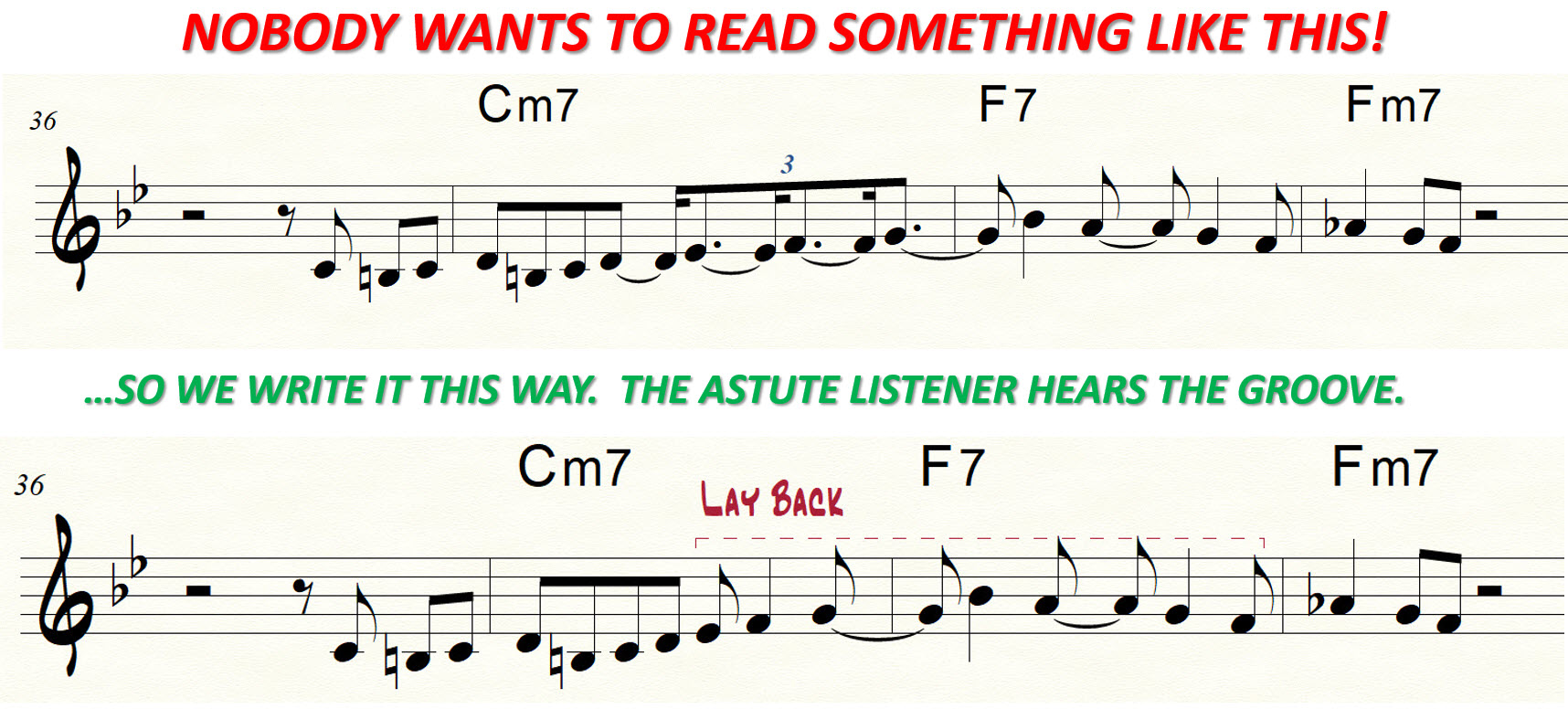
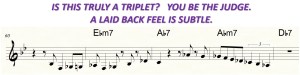
Masters like Dexter Gordon and Ben Webster enjoy pushing ahead or laying back on the beat. It’s subtle; just enough to excite or relax the feel without altering the written rhythm.
3. Repeat a Rhythmic Motif.
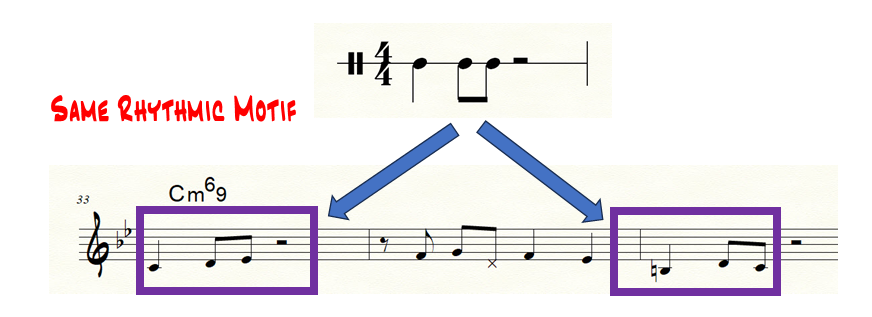
This 3-note rhythmic motif bookends the beginning and the ending of a short, 3-bar phrase.
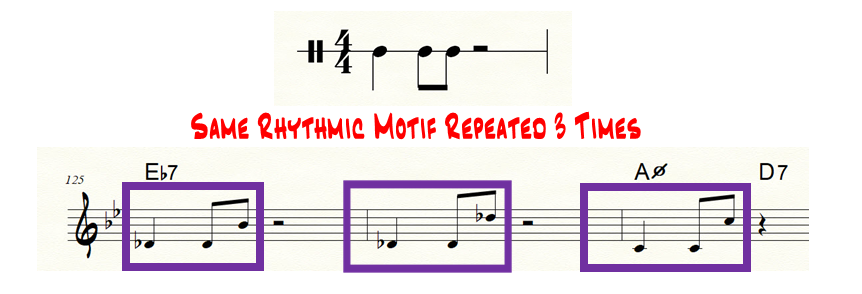
Here is the same 3-note rhythmic motif, this time repeated three times over a changing chord sequence.
MELODY: THE HEART
- Use Repetition to Add Unity.

This may not seem like much, just a simple 4-note motif. But its repetition lends emphasis and unity, even though the surrounding material is not the same.
- Grab On to Melodic Motifs.

Here is a 3-note melodic motif (from G to F to Ab) repeated five times, twice with a trailing C natural, three times without.
Repetition is powerful—but only when balanced with contrast. Antônio Carlos Jobim intentionally built “One Note Samba” around extreme repetition for humorous effect. In most solos, however, just enough repetition creates unity without becoming monotonous.
- Try Creating Sequences to Lend Even More Unity and Variety

Here is a 3-note rhythmic motif (2 eighth notes and a quarter note) repeated six times as the key changes. Since the pitch descends, the repeated motif also forms a melodic sequence, like steps on a musical stairway. Both devices contribute to the “unity, variety, and coherence” which make your solo memorable and easy to follow.
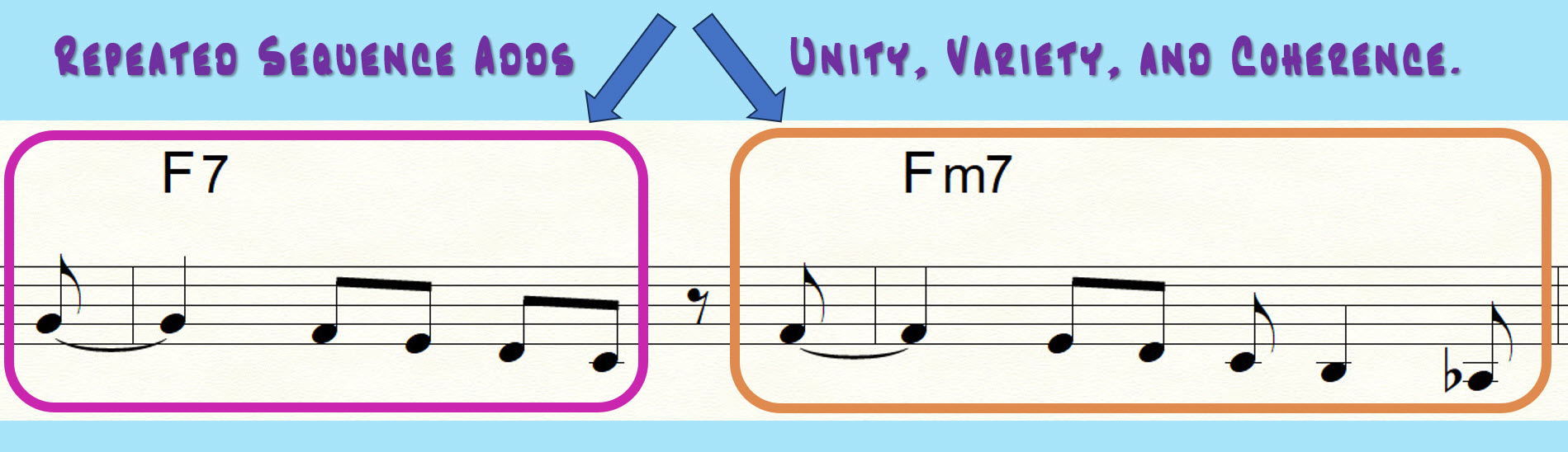
In this “modulating sequence,” the repeated melodic motif bridges the harmonic gap between F7 and Fm7.
- Create a Coherent Flow by Using a Characteristic Melodic Contour.

Although the short motif is one type of melodic idea, many other intriguing possibilities exist. For example, you might weave your lines in characteristic or unexpected ways. Notice how frequently this melody changes direction throughout its eight-bar duration. It repeatedly leaps upward and falls back, creating a jagged, zigzag contour. Yet the phrase is not wandering aimlessly: beneath all those changes of direction, the line gradually works its way downward. Combining frequent reversals with an overall trajectory creates both unpredictability and forward momentum along with a recognizable identity and a sense of destination.
There’s a lot of repetition in the above examples. I think it contributes to the unity and coherence of the performance without becoming redundant. Do you agree?
DISCOVER YOUR PERSONAL STYLE
Answering questions like the one above helps define and develop your personal improvisational style. For example:
- Would you rather play “inside” or “outside” the chord changes?
- Do you enjoy playing fast runs like Charlie Parker (“Bird”), or do you favor a more languid approach like Johnny Hodges?
- Are you more comfortable staying close to the original melody, or does exploring uncharted waters excite you?
As we listen to the masters, we are attracted to some aspects of their style more than to others. In this way, we gradually develop musical preferences that define our personal style, just as we are drawn to favorite foods, friends, and clothing.
Technique gives you vocabulary. Your artistic choices give you a voice.
JAZZ VOCABULARY: THE IDEAS
- Use Enclosures to Increase Suspense.

The example above is a simple enclosure whose approach notes (G# and B) encircle A, the root of the Am chord. That note is called the “target note,” the note which resolves the momentary dissonance. The “approach notes” create a brief moment of suspense as the listener awaits the resolution.

The picture above shows five different types of enclosures marked a., b., c., d., and e.
a. The target note, Eb (indicated by the red arrow), is the root of the Ebm chord . The two approach notes (D, and F) are shown in a blue box for easier identification. They are members of the Bb7 chord, but NOT of the Ebm chord. Together, they enclose the target note, Eb.
b. The target note, Eb, is the third of the Cm chord. The approach notes (F and D) are actually “neighbor tones.”
c. The target note, C, is the root of the Cm chord. The approach notes (B and D) create a typical half-whole enclosure. Although the B natural may look like an accidental, it’s actually the 7th degree of the C melodic minor scale.
d. The approach notes (F and D) are separated by two passing notes (Fb and Eb).
e. The approach notes (B and D) are separated by rests.
9. Combine Passing Tones and Enclosures to Outline an Arpeggio.

At Letter a.), we see a normal, everyday enclosure. The D# and the F# enclose E, the third of the C#m7 chord. By contrast, at Letter b.), the target notes F#, D, and B form an arpeggio of the Bm chord, while two sets of approach notes (E to C# and A# to C#) enclose the notes of the arpeggio. When I discover a riff like this in a transcription, I woodshed it in all 12 keys, since it might come in handy later on.
HARMONY: THE VOICE
Don’t Just Learn the Changes: Understand the Song’s Tonal Regions.
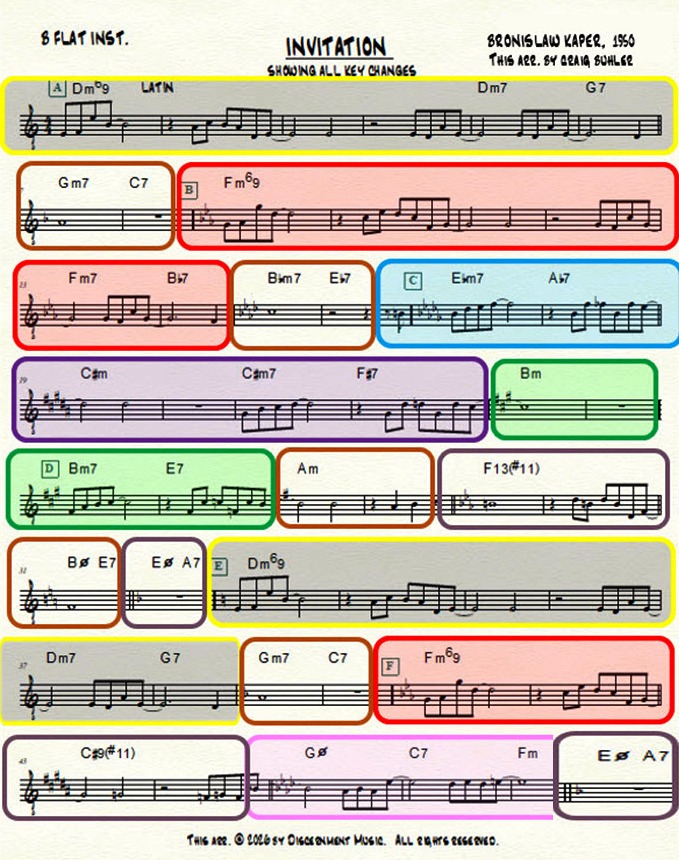
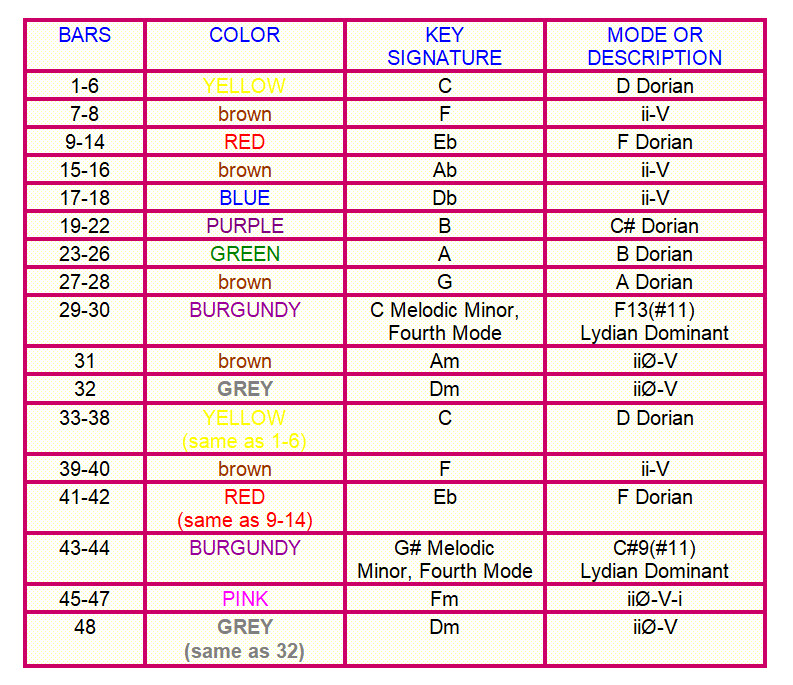
The lead sheet below highlights each tonal region in a different color. The table summarizes what each section represents and suggests a scale or mode you can use to play that passage.
Band in a Box or similar software will loop each of the colored sections as you experiment with the scale or mode described in the table.
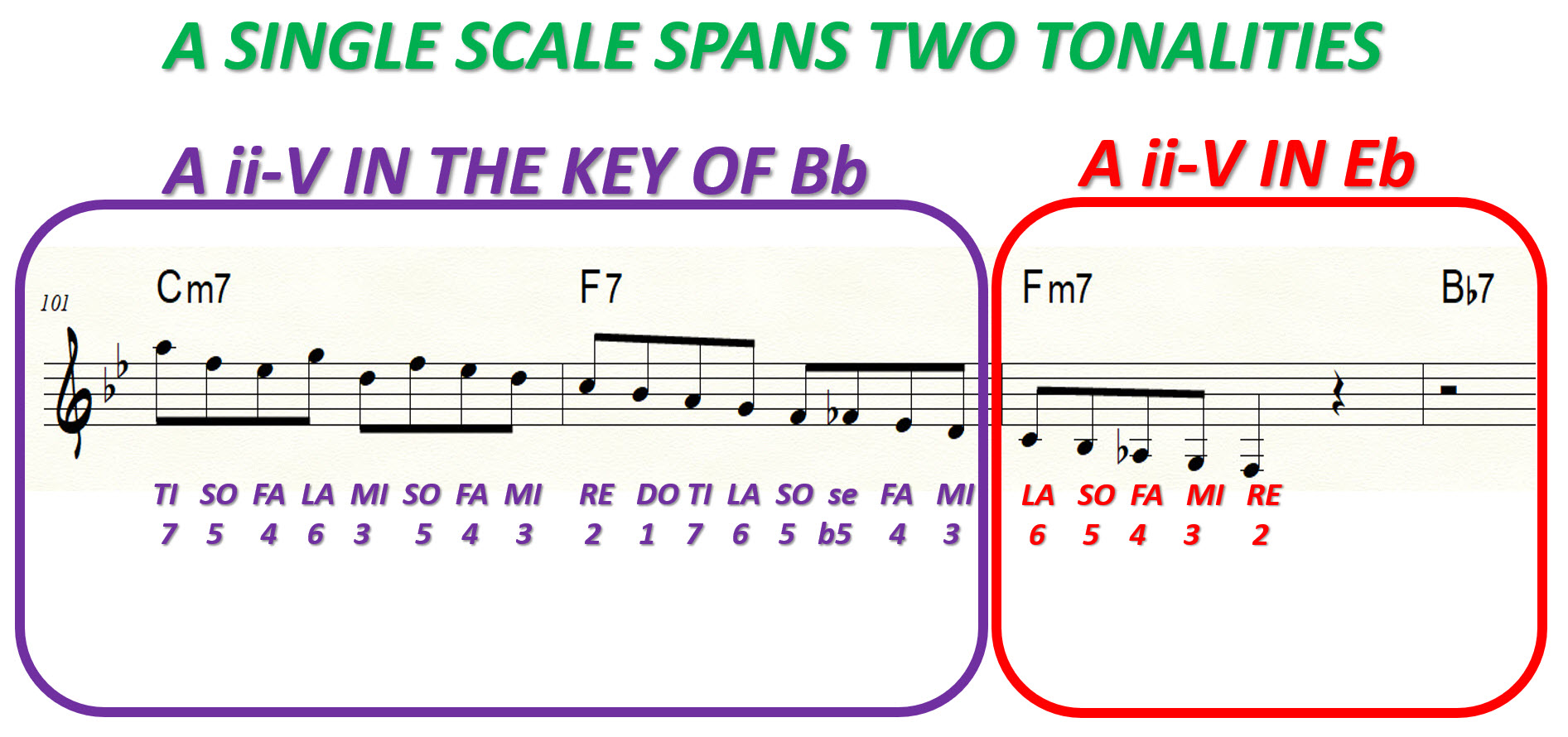
10. Use a Single Scale Spanning Multiple Key Signatures.
Great improvisers meld the changes into a coherent arc instead of a bunch of random licks, because they understand the larger tonal architecture of the tune.
One way to do that is to continue scalar momentum even when the key changes. The tonality shifts in the middle of this scale from Db major to Gb major.

Here is a second example of a contiguous scale spanning two tonalities. The continuity of scalar motion bridges the modulation.
CONCLUSION
Every solo reflects hundreds of small musical choices—where to begin a phrase, when to repeat an idea, how much tension to create, when to relax the rhythm, and how to connect one key to another. Rather than memorizing my solo, experiment with the ideas discussed here in your own playing. That’s how you begin to develop an improvisational voice that sounds unmistakably like you.
Bring the same creative energy to your solo you would pour into a love poem–because that’s what great improvisation is.
Listen to Craig’s Improv on “Invitation.” (Click on the MP3 player below.)
View a Complete Transcription of the Improv here. Leave a comment below, if you need a transcription in another key or in another clef.