Tag: MODES

The Tonic Dominant Seventh Chord

As you look through charts of blues tunes, you discover innumerable dominant sevenths serving as one chords (tonics).  Music theoreticians explain:  “Many blues melodies are in the Mixolydian Mode:  They use a major scale, but with a lowered seventh degree.  This is harmonized with a dominant seventh chord whose root is the tonic of the song.  The lowered seventh degree is referred to as ‘the first blues note.’”

A far more succinct, accurate, and readily digestible explanation is:  “The Mixolydian Mode begins and ends on SO,” so the scale is best described this way: Continue reading “The Tonic Dominant Seventh Chord”

A Harmonic Minor Workout

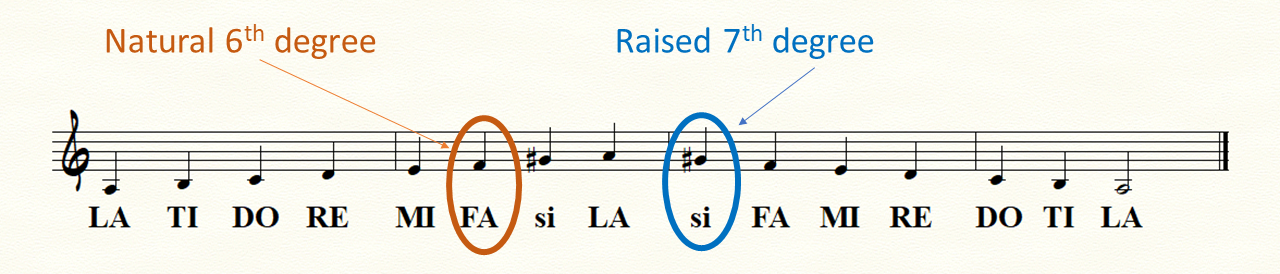
Pianist Dr. J. H. asked for a melodious exercise he could use to explore the harmonic minor scale in all 12 keys.  The “harmonic minor scale” features the natural 6th degree FA along with the raised 7th degree.  The raised 7th degree in a minor scale is the syllable known as “si” (pronounced “SEE”).  It’s also referred to as “#SO” or “#7.”   That scale is shown here:

Continue reading “A Harmonic Minor Workout”

Mode For Joe

Saxophonist Maria is improvising over Joe Henderson’s classic jazz standard  “Recorda-Me.”  I asked her whether she would use the Dorian or Aeolian mode over the first 4 bars.

As shown below, the Aeolian is the mode rooted on LA, so it uses a lowered 6th degree.  By contrast, the Dorian is rooted on RE, so it features a raised 6th degree.

Continue reading “Mode For Joe”

Another Blues Scale

Click here to watch the video.

The blues idiom offered early twentieth century musicians a new way to share deep emotional feelings vigorously and honestly.

A hundred thirty years earlier, Mozart had reveled in the fresh, airy lightness of the major tonality which superseded stolid Renaissance modal forms around 1600.

Periodic innovations like these keep music vibrant and invigorating.  Unfortunately, too many of today’s musicians bloat their playing with endless, unimaginative, repetitive blues licks.  Sure, blues licks can add a funky edge, but overuse of these clichés leads to tiresome monotony.

(And so on, and so on….Well, you get the idea!)

Continue reading “Another Blues Scale”