
Here is an enjoyable (though challenging) way to practice the harmonic minor scale. Continue reading “Don’t Just Practice Dry Technique: Practice Full Engagement With Your Music!”
Category: Music Education K-12
Cannonball Adderley: The Way You Look Tonight
Cannonball Adderley’s solo on “The Way You Look Tonight” is an amazing tourdeforce! He blazes through an entire chorus in 53 seconds. But, if you play this solo** at half speed, it is as melodic as a Johnny Hodges invention. Played in concert F, it is written for alto sax in D major. In this key, the bridge modulates to F major. However, the wonderful phrase shown below actually begins in G minor and ends in F major. Try playing this lick in all 12 keys. It works well over a II-V change. If you cannot figure it out on your own, email me for a free chart of the lick in all 12 keys. 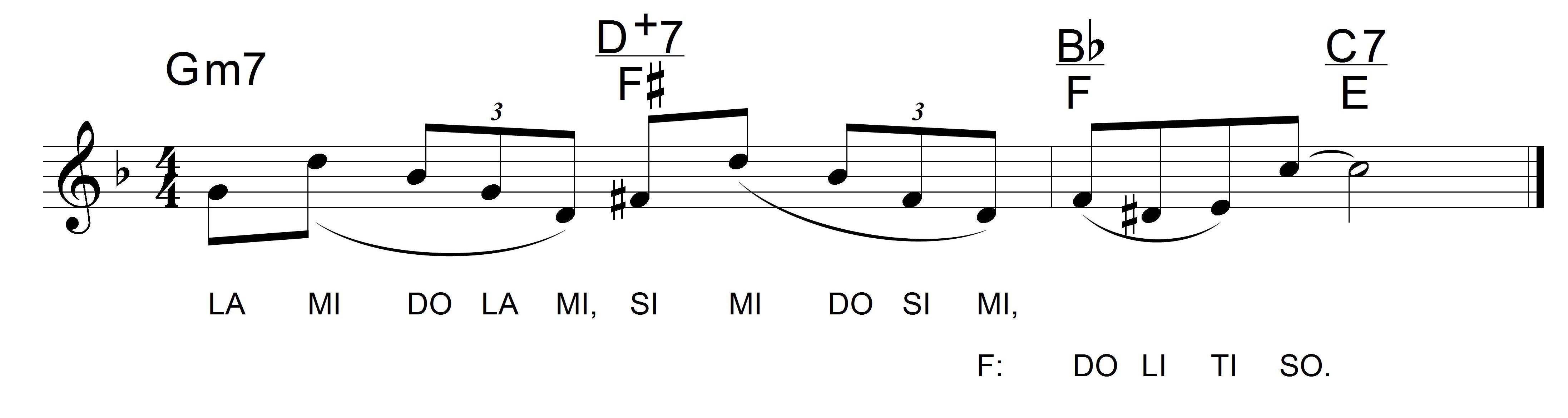
** This solo is found in “The Julian Cannonball Adderley Collection” edited by Tim Price, published by Hal Leonard.
Effortless Mastery
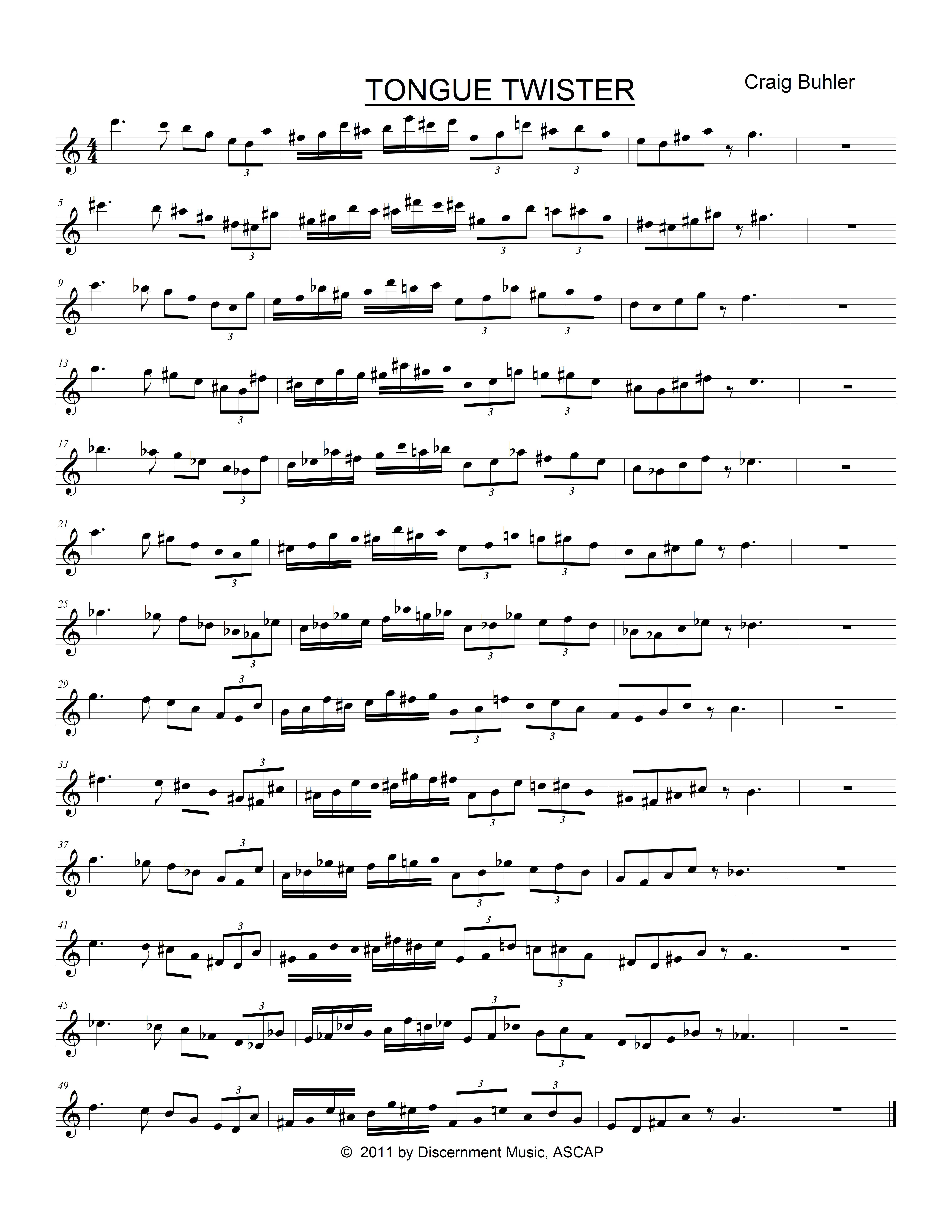
Here is an exercise to develop your rhythmic precision, finger dexterity, and improvisatory diversity.
In Kenny Werner’s book “Effortless Mastery,” he states that in order for a phrase to sound relaxed & swinging, it must be played effortlessly. How do you play a line like the one below and make it sound effortless? You must sacrifice one of these qualities:
- playing it fast
- playing the whole phrase
- playing it perfectly
Try looping little sections (as few as 2 notes) until they flow effortlessly. Use your metronome in order to keep the groove going smoothly. Start slowly and gradually extend the length, speed, and precision of what you are able to play effortlessly.
Charlie Parker: “An Oscar For Treadwell”
Page 43 of the Eb Charlie Parker Omnibook contains this cool phrase in lines 12 & 13. Why does this particular lick sound so nice over a V7 chord? One reason is that the 3rd of the chord (TI), the 7th of the chord (FA), and the 13th of the chord (MI) are prominently featured on the strong beats 1, 3, & 1 respectively. These are the most interesting notes in the chord. FA & TI form an attractive tritone, while MI is a major 7th above FA. The line also has an interesting contour.
Although Bird’s solo on “An Oscar For Treadwell” is in the key of A major (on alto sax), you will notice that the lick shown below – which occurs in the first 2 measures of the bridge – is in the key of F#. For the benefit of New Ears Resolution students, i have written in the solfége syllables below the notes. (The syllable “SE” – pronounced “say” – is between SO and FA.) As always, you will derive the maximum benefit from playing this phrase in all 12 keys. If you cannot figure out the notes in the other keys, email me for a FREE pdf of the complete chart and an mp3 recording you can practice along with.
The more you study the work of the masters such as Charlie Parker, the richer your own musical vocabulary will become. Playing the licks in all 12 keys develops your “hand / ear co-ordination” and prevents you from falling into “finger familiarity” ruts.

Ralph Moore’s Tenor Solo on “SOS”
Are you hip to Ralph Moore? He has a fabulous sound and great ideas. The following lick is taken from Ralph Moore’s solo on the tune “SOS” from the CD “Moore Makes 4” by the Ray Brown Trio with Ralph Moore. This is an amazing solo, packed with wonderful lyricism and dazzling technique. For details, see the book “Ralph Moore Jazz Tenor Solos” Transcribed by Bill Sears, published by Corybant Productions, Inc., 1994. I have recorded the lick in all 12 keys, so you can play along with the recording. On the following page is the link to the recording along with a chart showing the lick in all 12 keys. Below is an analysis of the various key centers traversed by the lick. You will note that the melody & the chord changes both adhere strictly to this key center scheme. (See “New Ears Resolution” for details on this analysis technique.)

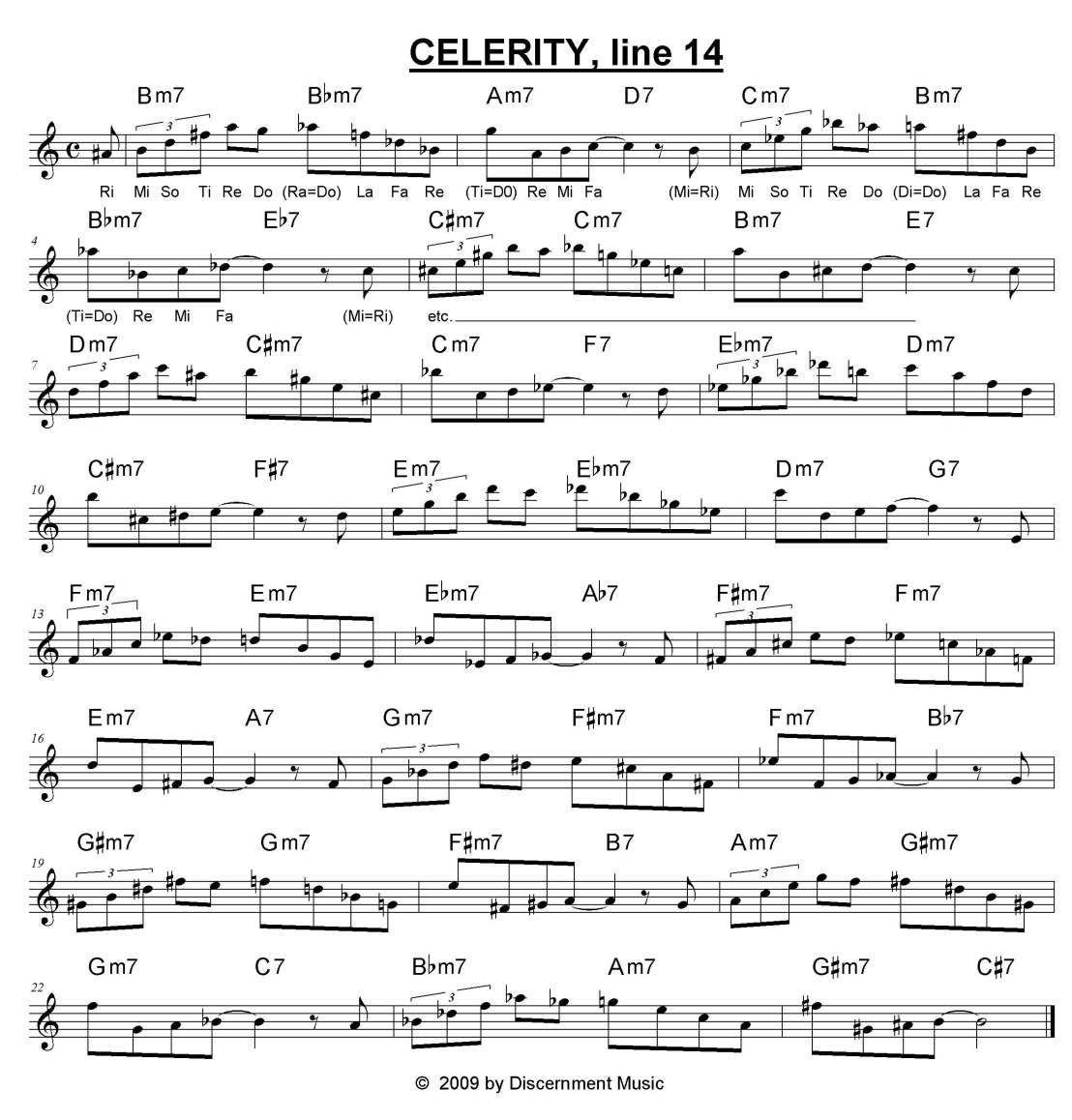
CELERITY: Bird transposes up a half step
This wonderful phrase illustrates how Charlie Parker (“YARDBIRD” or “BIRD”) could take a simple chord progression (such as III minor / bIII minor / II minor) and transform it into an opportunity to modulate. In this case, he raises the key by a half-step, a favorite be-bop modulation. (Thus, the bIII minor becomes a II minor in the key a half-step up from the original key.) To solo properly over this progression, you need to use the Ab major scale for beats 3 & 4 of measure 1, the G major scale for the rest of bars 1 & 2. Try it! As always, try to master the exercise without resorting to the printed page. Click here to hear the audio.
ANTHROPOLOGY (Charlie Parker)
There are so many great phrases in this classic solo. This one deserves attention because of its rhythmic & melodic vitality and its effortless harmonic insinuation. Click below to see the phrase in all 12 keys. However, it is better to practice your ear training by figuring out the lick through melodic extrapolation. Click here to purchase the Charlie Parker Omnibook with its 142 pages of heads & transcribed solos by Bird. Click here to hear a play-along version. (To slow it down or change the key, download the free program “Best Practice.”)
Half Diminished (Minor Seven, Flat Five)
This arpeggio is very useful over a V7 (or a V9) chord. Notice that the iteration beginning on A# is actually in the key of C major. The A# is LI (sharp 6) in the major scale. For “New Ears Resolution” students, also note that the key change is indicated by the presence of a “pivot note.” Marked as (TI=LI), this notation is understood to mean “The note B natural, (TI in the old key of C major) will now become LI in the new key of Db major.” Once grasped, this understanding of modulation as described by a pivot note is a very powerful concept when one attempts to navigate the changes of a song with many internal key changes (such as “All the Things You Are.”)

New Jazz Blog
Here is a new resource for jazz fans. Check out http://jazzbreak2.blogspot.com:80/
OVERCOMING FLAPPY FINGERS
From a quick viewing of YouTube video footage, it appears that Coltrane’s fingers may move further from the keys than do Bird’s. Do you agree?
Play on regardless: Music is therapy
WHY should real musicians – the ones who can actually play their instruments – have all the fun?
“Capistrano Sessions” & “Larger Than Jazz” now available as MP3 downloads from CDBaby
You can now download MP3 copies of our 2 best-selling CDs from CD Baby for $9.00 per CD.
Music, Brain Function, and Intelligence
Music Makes You Smarter. Continue reading “Music, Brain Function, and Intelligence”
Jazz Musicians as Role Models
Is it possible for an older jazz musician to influence younger players in a constructive way? Continue reading “Jazz Musicians as Role Models”
Charlie Parker Teaches Focus
Have you tried reading the charts in the Charlie Parker Omnibook? I find that some of them require a level of focused attention that is quite difficult to maintain over a 3-hour practice session.
Cool uses for the Charlie Parker Omni Book
There are so many wonderful phrases that Bird created. When one phrase in particular captures my imagination, i try learning it in all 12 keys. Continue reading “Cool uses for the Charlie Parker Omni Book”
Modulation
Do you ever grow attached to a key and find yourself resisting modulation into a new key?
On Tone Control and Playing in Tune
Written by noted woodwind artist & teacher Signe Crawford for the “Keys to Music” collection of jazz etudes.
Think of tone as your material for creating music.
If you can create a good tone, good pitches will follow.
If you can create a good pitch, a good tone will follow.
Can You Learn to Play by Ear?
New Ears Resolution has helped hundreds of musicians learn to play by ear over the past 15 years. And now, the Second Edition offers scores of new innovations designed to make your learning experience more enjoyable, effective, and thorough.
 Whether you work with a jazz combo, rock group, or big band, or just play for your own pleasure, “New Ears Resolution” will help you become the musician you have always wanted to be.
i’ve taught this method for years and have used it in my own performances. i’ve researched extensively in order to improve its design and have thus developed a comprehensive approach to the art of playing by ear.
HOW IS “NEW EARS” DIFFERENT FROM OTHER METHODS?

“New Ears Resolution” is a hands-on method. Learn to play by ear by playing, rather than studying abstract theory! It’s fun, and it’s practical.
The audio contains 26 enjoyable play-along tracks in many different styles: swing, bossa, bop, rock, folk, country, jazz waltz, ballad, and fusion.
The 78-page book includes charts for each of the 26 exercises along with clear, simple instructions and lots of handy tips on how to succeed on the gig or in the jam session.
HIGHLIGHTS OF THE SECOND EDITION
Learn to use these scales:
- Major
- Natural Minor
- Harmonic Minor
- Melodic Minor
- Blues Scale
- Extended Blues Scale
Learn to use the following modes:
- Ionian
- Dorian
- Phrygian
- Lydian
- Mixolydian
- Aeolian
- Locrian
Learn to improvise over these chords:
- Triads
- Major Sevenths
- Dominant Sevenths
- Minor Sevenths
- Minor 7 Flat 5 (Half Diminished)
- V7(b9)
- sus b9
- V7#9(#5)
- Diminished
- Augmented
Learn how to navigate key changes (modulations) smoothly and effortlessly.
Learn techniques for improvising.
Learn about harmonic context.
Understand how to play over these progressions:
- The ii-V-I progression
- The I-vi-ii-V progression
- The 12-bar blues progression
Learn the art of melody embellishment.
Learn how to play polytonal passages.
Master rhythm and learn to swing!
PDF Book & Music – $9.99
Or Printed Book & CD $19.99
Thanks to the reliable FastSpring delivery system, you can begin your ear training study right now. You will receive the 78-page “New Ears Resolution, Second Edition” ebook (as a pdf file) along with the 26 mp3 audio files, all in a quick downloading zip file.
$9.99
- For Treble Clef, Concert Key Instruments (piano, guitar, violin, flute, organ, vibes, mandolin, etc.)
- For Bass Clef, Concert Key Instruments (trombone, upright & electric bass, etc.)
- For Bb Instruments (trumpet, clarinet, tenor sax, etc.)
- For Eb Instruments (alto sax, baritone sax, etc.)
Or purchase the physical book & CD via PayPal.
$19.99
- For Treble Clef, Concert Key Instruments (piano, guitar, violin, flute, organ, vibes, mandolin, etc.)
- For Bass Clef, Concert Key Instruments (trombone, upright & electric bass, etc.)
- For Bb Instruments (trumpet, clarinet, tenor sax, etc.)
- For Eb Instruments (alto sax, baritone sax, etc.)
CAN YOU LEARN TO PLAY BY EAR? YES YOU CAN!
How do i know? Because I have taught over 100 musicians to do it over the past 15 years. These are musicians of all ages and levels of ability on various instruments, and you can be one of them.
Playing by ear is a thrilling experience. With this skill, your instrument can reproduce any song you can whistle or imagine, in any key. You can write down melodies while sitting on an airplane, without consulting a piano. How is this wonderful feat accomplished?
There are two ways a person plays by ear. Either you are born with perfect pitch or you learn to play by ear using relative pitch.
One in 10,000 people is born with perfect pitch. These rare individuals can hear any note and tell you what that note is. Some folks say perfect pitch can be learned, but I am very skeptical of these claims.
Relative pitch – by contrast – is the ability to name any note once you have been given a reference pitch. You figure out the second note by calculating its distance from the given note. I can teach you to do this.
In order to improvise, you must be able to transfer any melody you hear (on the radio, in your memory, or in your imagination) to your fingers and your instrument.
How do You Do It?
My “New Ears Resolution” ear training method is based on the “movable Do” system as elaborated by my teacher, Alvin Learned. Al was Dean of the legendary Westlake School of Jazz, which trained many of the leading Los Angeles musicians of the 1950’s, including Paul Desmond, Les McCann, and Billy May.
By playing along with the “New Ears” audio tracks, you learn to discern the relative position of various notes in a scale, and you become adept at finding any scale degree on your instrument in any key. The difference this makes in your playing is immediate & dramatic!
Visualize two typists, one laboriously “hunting & pecking” for each letter, the other effortlessly “touch typing,” spinning out error-free paragraphs. Now imagine two musicians, one painstakingly searching for each note (by trial & error), the other soaring through a melody as if it had been carefully memorized.
A very talented and ambitious young student told me he was trying to memorize one tune per week in all 12 keys. I responded, “That sounds like a mountain of work, and it will take you 10 years to build a repertoire!”
When you play a song by ear, you do NOT memorize the sheet music. Rather, you hear the tune in your imagination, calculate the tune’s formula in real time, and translate the formula into actual notes in any desired key on your instrument, also in real time.
This may sound like it would consume a staggering amount of brain power, but the process becomes amazingly simple, once you have worked through the exercises contained in the “New Ears Resolution” package. The 26 exercises on the CD (or mp3 download) start out quite simply and grow increasingly complex as your ability and confidence grow.
You will play along with the 72-minute audio a minimum of three times.
- The first time, you read through the charts given in the “New Ears” book while you play along with the audio track. This also helps refine your sight reading ability.
- The second time, you play along with the recording without looking at the book. You are now playing the exercises by ear. This increases your confidence.
- The third time through, you improvise variations as you play along with the recording. This builds your improvisatory vocabulary.
While this method is primarily designed to teach you to play by ear in all 12 keys, many other benefits are derived from practicing with the “New Ears” recording.
- Your sight reading grows stronger.
- Your tone develops.
- Your intonation improves.
- Your rhythmic sense increases.
- You begin to develop an improvisational vocabulary.
- Your confidence blossoms.
While the majority of my students incorporate the “New Ears Resolution” ear training method within a series of 12 or more one-hour private lessons, scores of self-motivated students have found they can learn on their own from the book & audio tracks.
The brand new, comprehensively redesigned Second Edition answers numerous questions which more than a hundred students have asked me over the past 15 years. Its 26 audio tracks and 78-page book are packed with helpful tips to prepare you for the gig & the jam session.
Students who encounter questions or road blocks along the way need only send me an email, and the issue will be promptly addressed.
PDF Book & Music – $9.99
Or Printed Book & CD $19.99
Thanks to the reliable FastSpring delivery system, you can begin your ear training study right now. You will receive the 78-page “New Ears Resolution, Second Edition” ebook (as a pdf file) along with the 26 mp3 audio files, all in a quick downloading zip file.
$9.99
- For Treble Clef, Concert Key Instruments (piano, guitar, violin, flute, organ, vibes, mandolin, etc.)
- For Bass Clef, Concert Key Instruments (trombone, upright & electric bass, etc.)
- For Bb Instruments (trumpet, clarinet, tenor sax, etc.)
- For Eb Instruments (alto sax, baritone sax, etc.)
Or purchase the physical book & CD via PayPal.
$19.99
- For Treble Clef, Concert Key Instruments (piano, guitar, violin, flute, organ, vibes, mandolin, etc.)
- For Bass Clef, Concert Key Instruments (trombone, upright & electric bass, etc.)
- For Bb Instruments (trumpet, clarinet, tenor sax, etc.)
- For Eb Instruments (alto sax, baritone sax, etc.)
Psych Yourself Up to Play Fast Tempos!
I’m not by nature a fast player. I don’t do anything fast except breakfast.
Latest Update on Sticky Saxophone Pads
Every sax player I have ever known struggles with the G# key sticking in the closed position. updated May 26, 2022
SWAB IT! How to Keep Your Saxophone Clean
You spent a lot of money on that horn. How can you make sure it will give you great service for many years to come?
Written by Daniel “Dr. Dan” Parker
Continue reading “SWAB IT! How to Keep Your Saxophone Clean”
Practice Priorities
How you can develop an effective practice routine and get the most benefit from your practice time
 CRAIG BUHLER JAZZ