
Benny Golson is widely respected as a consummate saxophonist, composer, and arranger, and “Whisper Not” is among his finest pieces. While improvising over its changes is invigorating, it’s also a challenge! Click “continue reading” for some tips on how to effectively ad lib on “Whisper Not.”
Listen to Craig Buhler’s improvised tenor solo on “Whisper Not” over a salsa groove at 175 BPM.
Click to watch the video with a complete transcription.
Contents:
- Learn To Navigate The Changes.
- Vary Your Phrasing and Rhythmic Patterns to Grab the Listener’s Attention.
- Create Interesting Contours.
- Hear the Recording and See the Transcription
Learn To Navigate The Changes.
“Whisper Not” enters a new tonal center every few bars, so you’ll need to use different scales to match the “key of the moment.”
Here’s an picture of the 32-bar, AABA form showing the chord changes and the keys they infer.
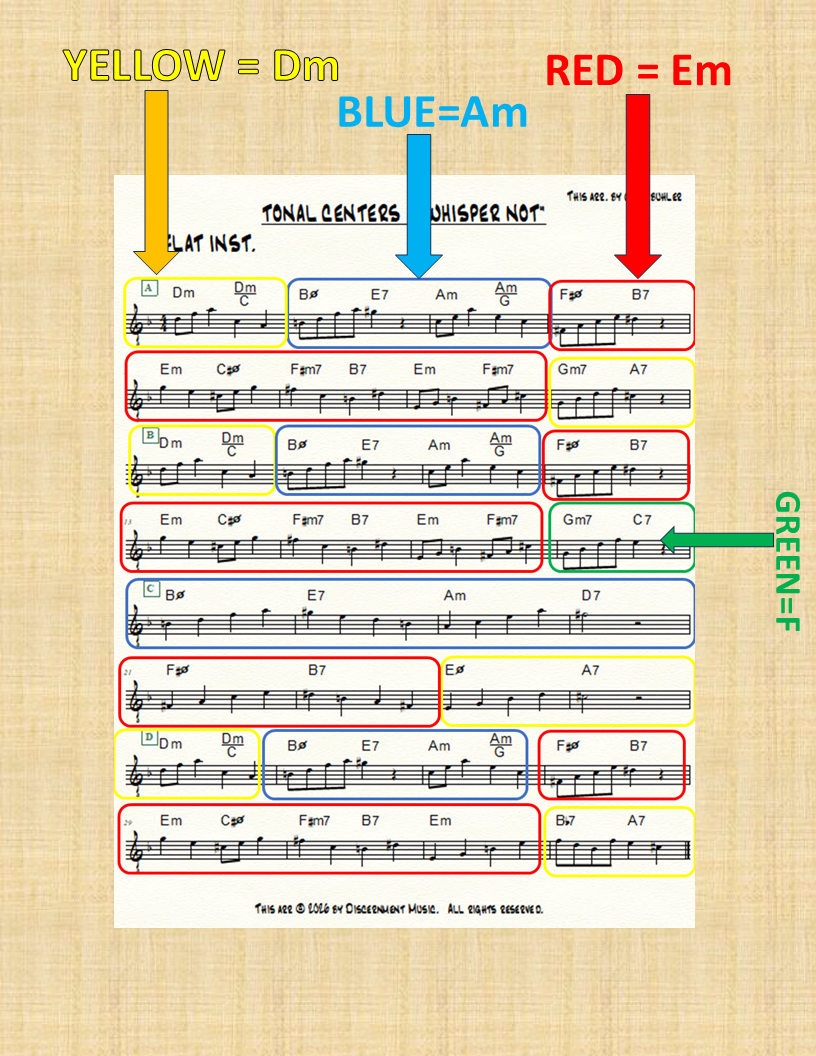
As indicated by the yellow boxes, the EØ-A7-Dm is a ii-V-i in D minor. Similarly,Gm7-A7-Dm is a iv-V-i, and Bb7-A7-Dm is a VI-V-i also in D minor.
Set up loops containing these cadences of two or four bars so you can experiment with the various minor scales (Natural, Harmonic, Melodic, Dorian, and the Blues Scale) to determine your personal preferences.
NOTE: To create these loops, you’ll need to download one of the FREE apps such as “Best Practice” so you can slow down the tempo and loop each section. Either use my recording or create background tracks with an app such as Band in a Box, Waveform Free, GarageBand, or LMMS.
As indicated by the blue boxes, the BØ-E7-Am-D7 progression is a ii-V-i-IV in A minor. (Although the D7 threatens to move into G major, the G major never materializes, so you can safely ignore it.)
In the same way, the red boxes point out sections which are in the key of E minor. The progression Em-C#Ø-F#m7-B7 is the ubiquitous i-vi-ii-V sequence more commonly seen in major keys on songs like “I Got Rhythm” or “Blue Moon.”)
The green box points to a brief foray into the key of F major, which can safely be ignored if you desire.
If you don’t yet feel confident in your ability to explore these various tonal centers, you can use the arpeggios sketched out in the chart shown above. In addition, my YouTube video contains five improvised choruses which I transcribed for you to use as you like. Earmark any phrases that strike your fancy and add them to your musical “vocabulary.”
Vary Your Phrasing and Rhythmic Patterns to Grab the Listener’s Attention.
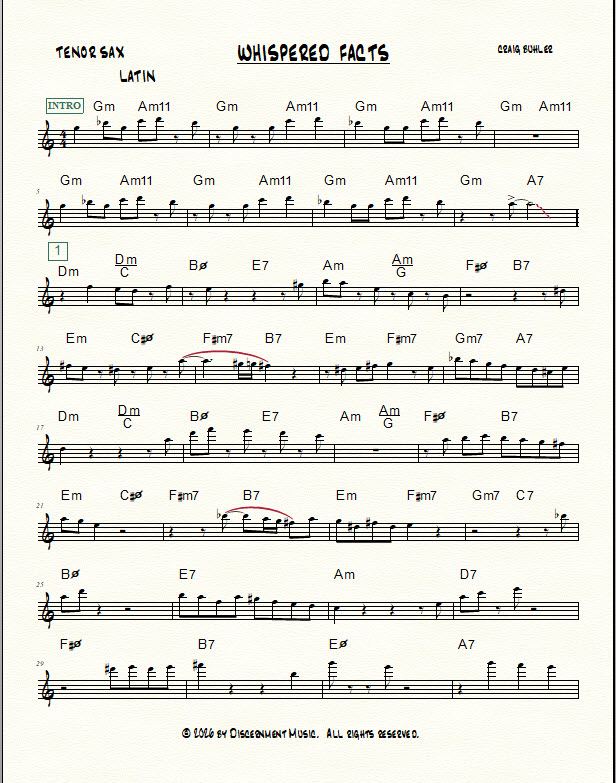
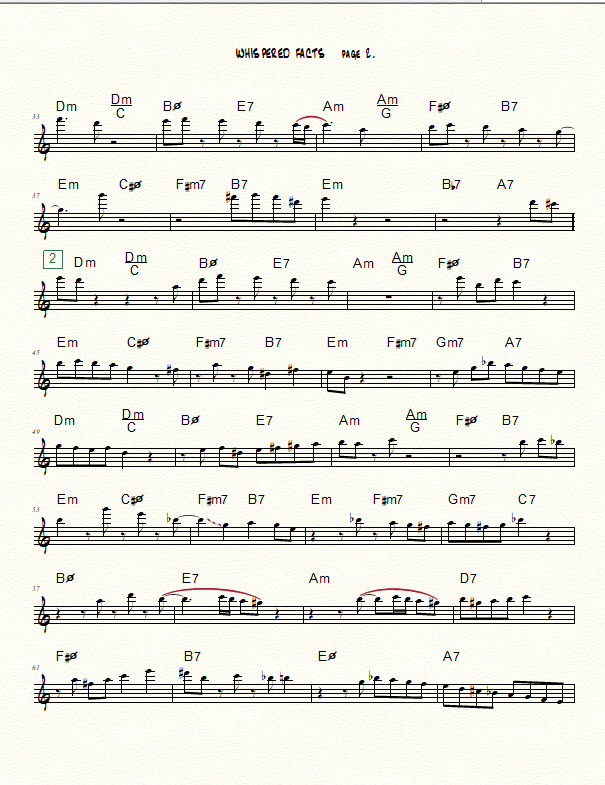
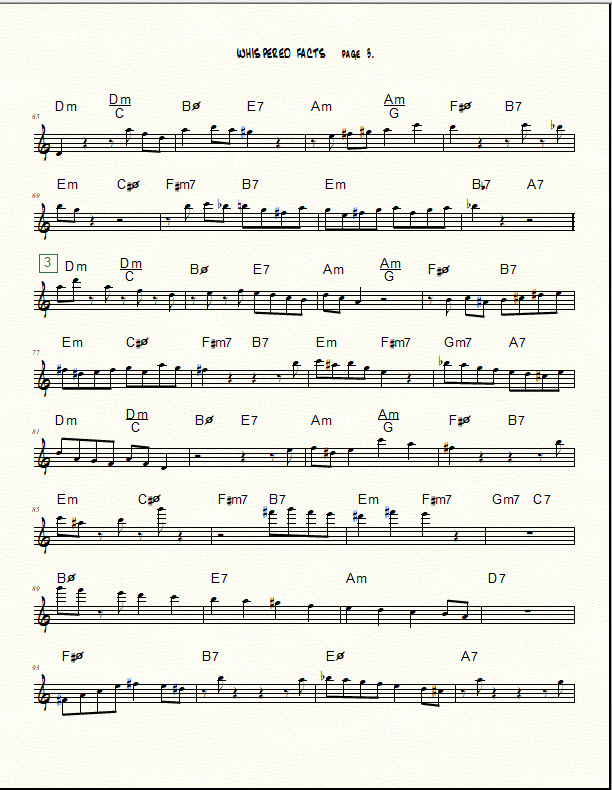
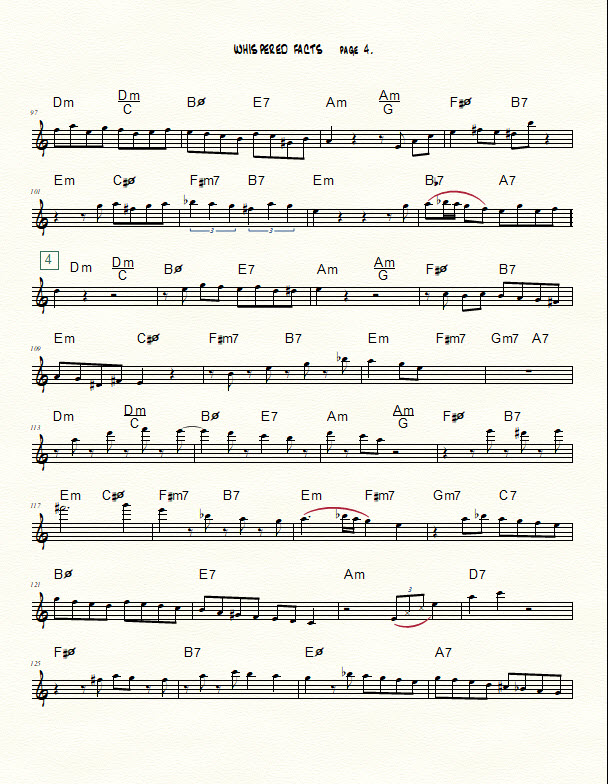
A transcription of my five-chorus improv over the changes to “Whisper Not” for Bb instruments is provided at the bottom of this post. (Contact me using the “contact us” form at the bottom of this post if you need a chart in another key or in bass clef.) The beginning of each chorus is marked with a boxed number. As you peruse the chart, notice the use of diverse rhythmic figures such as those described below.
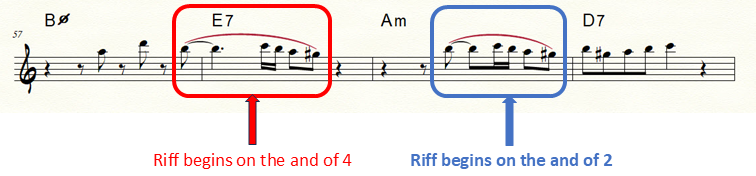
a.) Below is a picture and recording of bars 57-60. They contain a motif which is repeated, but not on the same beat. The first time, the lick starts on the and of beat 4, the second on the and of beat 1. This is called playing “on the other side” (the other side of the beat or bar).
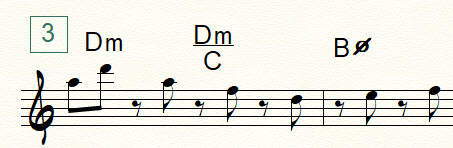
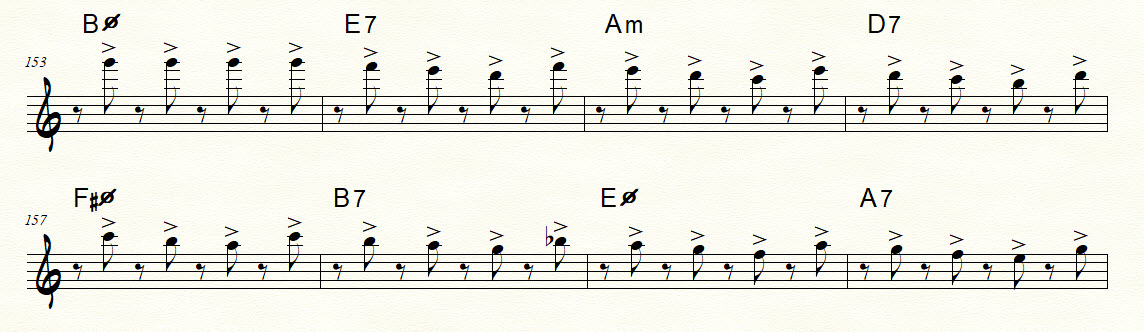
b.) The beginning of chorus 3 shows a series of 5 eighth notes on upbeats, almost like a syncopated stutter. This prepares the way for similar clusters of eighth notes, culminating in the bridge at bar 153 consisting of 32 (!) consecutive eighth notes on upbeats.
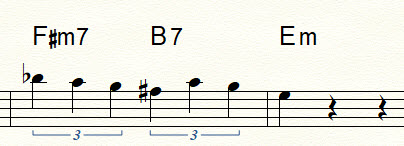
c.) The quarter-note triplets at bar 102 have the effect of “putting on the breaks,” momentarily slowing the momentum. Quarter note triplets are often accented to add impact.
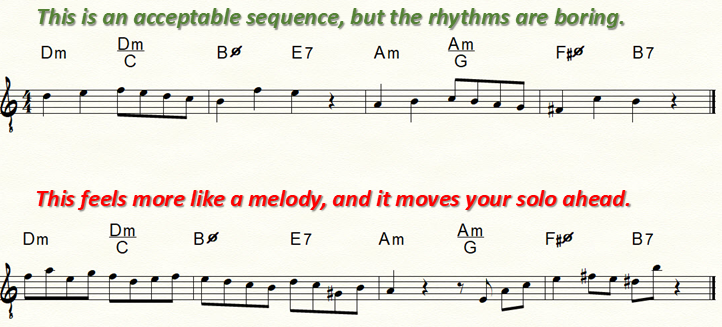
d.) What other rhythmic patterns do you see in the five-chorus transcription which jump out at you? Rhythmic variety as found in bars 97-100 is generally far superior to the predictable symmetry often heard in a phrase like this:
Create Interesting Contours.
On a clear winter day, looking toward the Olympic Mountain Range, you see its intriguing contours, the heavy snowpack accentuating its unique sawtooth pattern. In the same way, you can shape your melodic phrase so its contour captivates your audience. Below you see bars 149-151, The colored lines emphasize the melodic contour of this phrase.
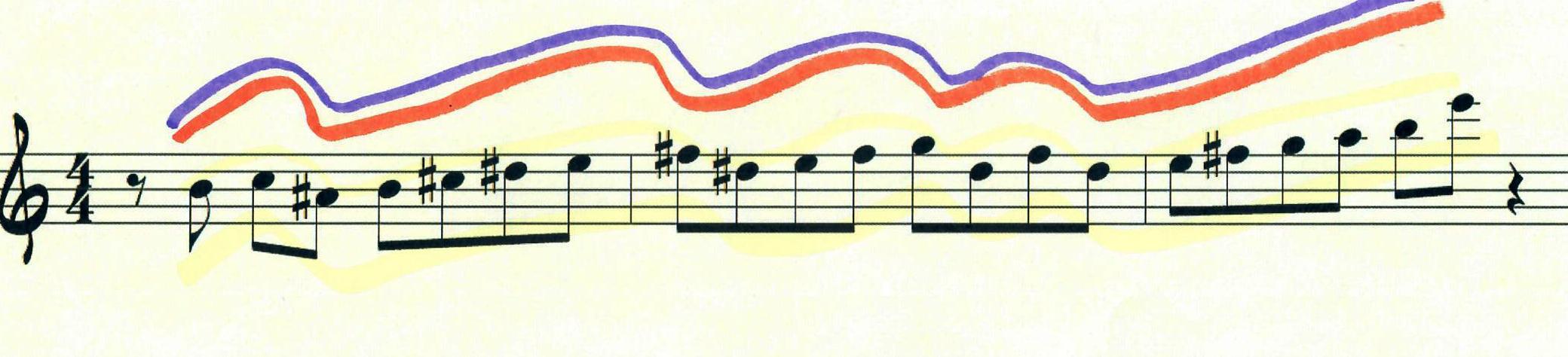
Shapes like this lend momentum and character to your phrases. As you look at my transcription, do you see other interesting contours?
In those old Fred Astaire, Ginger Rogers movies, do you recall how they fluidly migrate around the dance floor? That adds dimension to the scene and helps keeps your attention focused. In the same way, notice how some sections of my solo are confined to a specific register within the horn’s range, while others plummet or soar to higher or lower octaves. For example, the introduction (the first eight bars) has a range limited to only a perfect fourth (from G up to C). Bars 108 to 109 stay in the middle of the staff. But bars 121 to 122 drop a full 12th, while bars 123 to 124 ascend an entire 13th. To add variety, try experimenting with the high and low extremities of your instrument’s range.
One last observation regarding all the phrases in this solo which may contribute to its unified feel: each phrase ends on a target note, a “chord tone” (the note in the chord which needs to be emphasized in order to accentuate the harmonic movement). The phrase may arrive at its destination using scales, arpeggios, large skips, and/or enclosures, but the target note is always reached at phrase end.
Hear the Recording and See the Transcription
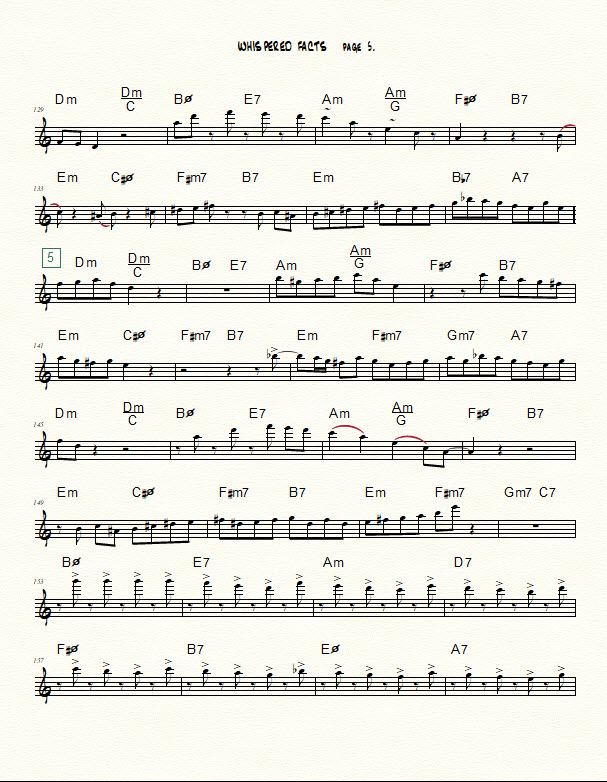
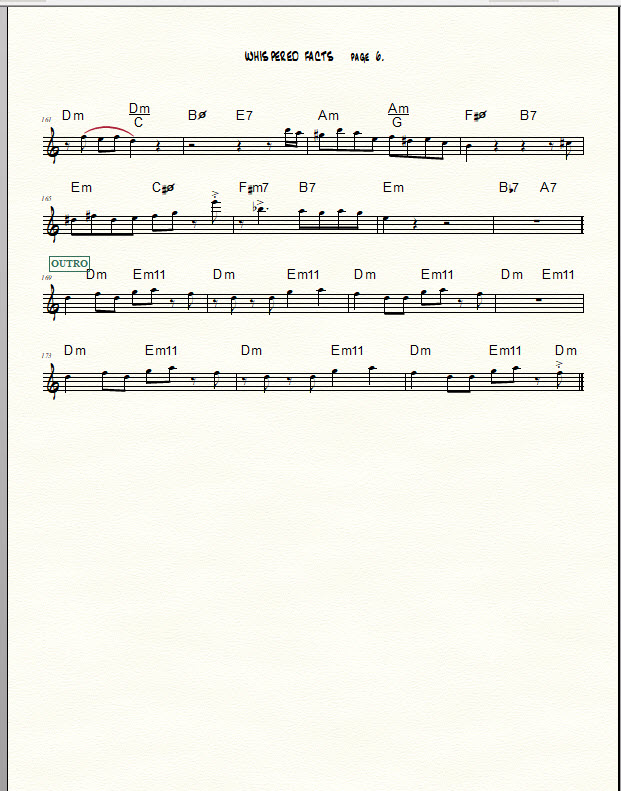


 CRAIG BUHLER JAZZ