
 There’s been a lot of buzz in the jazz literature lately about “enclosures.” That’s a 50 cent word with a meaning similar to the classical “Cambiata.” It’s generally a 3-note figure in which the first 2 notes lie above and below the final target note, a chord tone. A perfect example would be the first 5 notes of “Smoke Gets in Your Eyes” as shown below.

The D and the F are not in the F# dim7 chord, but the Eb and the C are. One use for such a device is to make a bland chordal tone sound far more interesting.
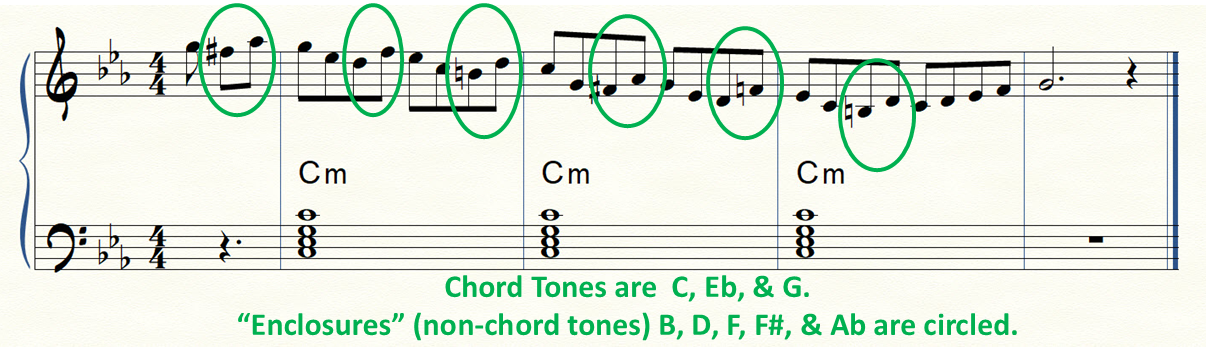
For instance, consider Oliver Nelson’s classic tune “Cascades” from his monumental 1961 LP “The Blues and the Abstract Truth.” In the chart below, I circled the non-harmonic tones (notes that are not part of the Cm triad) which create the “enclosures.” If you delete those notes, you’re left with a pretty boring melody, a C minor arpeggio.
While warming up on alto sax the other day, I stumbled on this 4-bar riff.
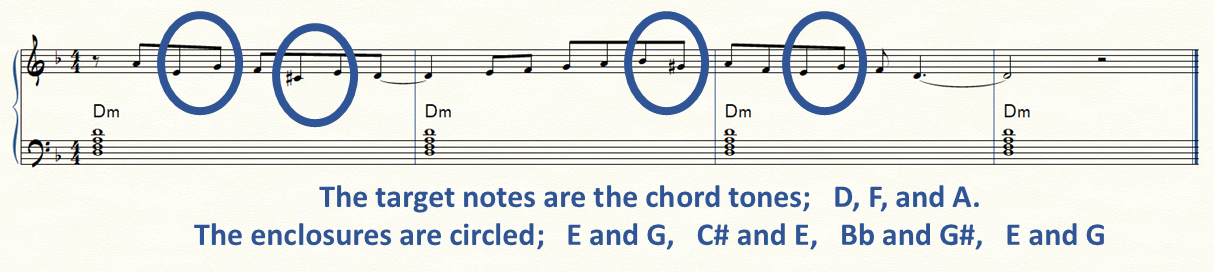
At the time, I wasn’t thinking about “enclosures” at all. This type of device eventually becomes a part of the improviser’s “tool kit” (or “vocabulary,” if you prefer). Below is a chart and a recording of that phrase in all 12 keys. You can woodshed my lick to master the idea of using “enclosures” in your own improvisation.
Along those same lines, my new book, “12 Keys to Improv,” contains a large collection of riffs in 12 keys. Working through those phrases will stimulate your creative imagination, enlarge your improv vocabulary, and supercharge your chops. Click on this link to purchase either the physical book + USB drive or the zip file download.


 CRAIG BUHLER JAZZ