
 As you look through charts of blues tunes, you discover innumerable dominant sevenths serving as one chords (tonics). Music theoreticians explain: “Many blues melodies are in the Mixolydian Mode: They use a major scale, but with a lowered seventh degree. This is harmonized with a dominant seventh chord whose root is the tonic of the song. The lowered seventh degree is referred to as ‘the first blues note.’”
A far more succinct, accurate, and readily digestible explanation is: “The Mixolydian Mode begins and ends on SO,” so the scale is best described this way:

You can see that this G Mixolydian Mode has the same key signature as C major: no sharps, no flats.
Every blues harmonica player knows that. That’s why harp players always use a C harp when they play a G blues, even if they can’t tell you why.
This is a case in which the tonic – “one of the mode” – is SO.
Students often ask, “Why use syllables, when numbers are more intuitive?” Here’s the answer:
DO IN NOT ALWAYS ONE!
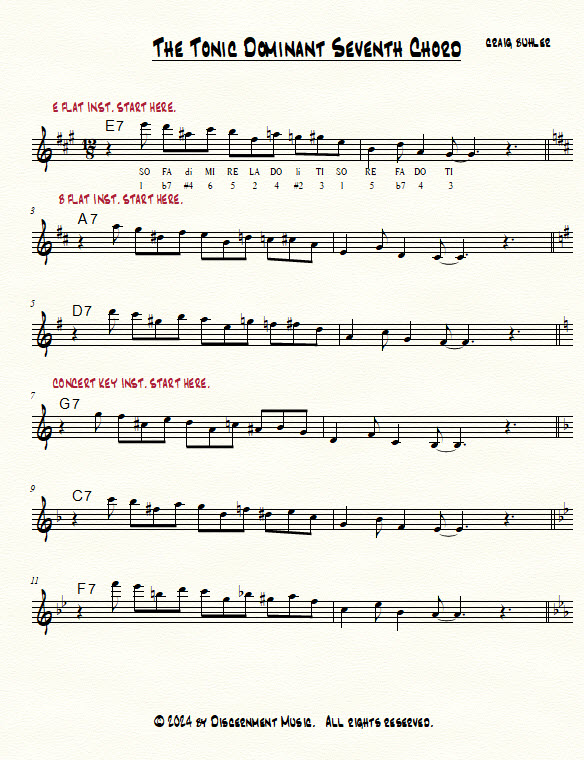
Try playing this simple Mixolydian phrase while reminding yourself that SO (not DO) is one.
 You can see that using syllables leaves you with only two accidentals, each of which can be explained in terms Bach would understand and approve. By contrast, using numbers saddles you with four accidentals.
Playing this phrase in all 12 keys will beef up your blues chops in a hurry! Find the chart and recording below.
If you agree with me that playing phrases like this in all 12 keys is a fabulous way to supercharge your practice routine, download “12 Keys to Improv” today, and begin your adventure into the thrilling world of advanced improvisation.

 CRAIG BUHLER JAZZ